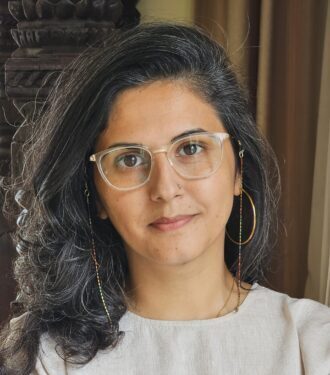
Sadikshya Dulal is a policy advocate working at the intersection of institutional design, exclusion, and climate governance. She holds a master’s degree from LSE, where she was introduced to institutional theory through the varieties of capitalism framework and comparative political economy, and trained in analysing how different institutional configurations shape labour market and social outcomes. This provided the foundation for her sustained engagement with questions of institutional design and exclusion. She studied research methods at ANU and has taught at several Australian universities including ANU, the University of Queensland and Queensland University of Technology.
Her engagement with institutional exclusion and collective advocacy began early in her career. During Nepal’s constitution-making process, she contributed to establishing a Confederation of Resource-Based User Federations bringing together the Federation of Community Forestry Users Nepal, the Federation of Drinking Water and Sanitation Users Nepal, the National Federation of Irrigation Water User Associations, the National Association of Community Electricity Users Nepal, and land rights organisations to collectively advocate for constitutional recognition of community resource rights, with sustained engagement across the Constituent Assembly through multiple rounds of drafting.
Over the last twelve years, she has bridged academic inquiry and policy practice working with think tanks in Nepal and consulting for USAID, the Bill & Melinda Gates Foundation, and PwC across South Asia and Southeast Asia examining institutional barriers to inclusion. Her research on maternal employment analysed how gendered institutional arrangements constrain women’s labour market participation. Her research on fiscal federalism examined how decentralisation in post-conflict Nepal both promised and constrained self-determination for marginalised groups. Her studies of decentralised governance explored how formal structures intersect with informal norms to shape who participates in decision-making. Across these contexts, she traces how institutional design determines whose lived experience matters and whose knowledge counts. Her work on disability rights extends this analytical lens to examine how the UN Convention on the Rights of Persons with Disabilities is translated into practice across different democratic systems, and how the participatory mandate of “nothing about us without us” is realised or constrained by institutional, structural, and ideational barriers.
She currently works as Head of Research and Advocacy at the National Ethnic Disability Alliance (NEDA), Australia’s national peak Disability Representative Organisation, having built a national research and grant portfolio largely from a standing start. She secured NEDA’s first competitive National Disability Research Partnership grant and developed a national framework for inclusive arts for a Commonwealth-funded grant project. She actively engages in carrying out inclusive research through partnerships with several universities in Australia. She has represented NEDA’s constituency before international and parliamentary bodies, including the UN Committee on Economic, Social and Cultural Rights and Parliamentary Hearings. She serves on several national and state-level advisory groups, including the Queensland Reconstruction Authority’s Community Reference Group, and has appeared on ABC News and SBS News as a subject matter expert on disability reforms.
As GEDSI Advisor at SEFNep, she brings this same institutional lens to the climate and environmental governance space, examining how gender, ethnicity, and disability shape whose knowledge and lived experience are reflected in climate adaptation, resource management, and policy decision-making and working to ensure that those most affected by climate change are genuine participants in, rather than subjects of, the policies designed to address it.